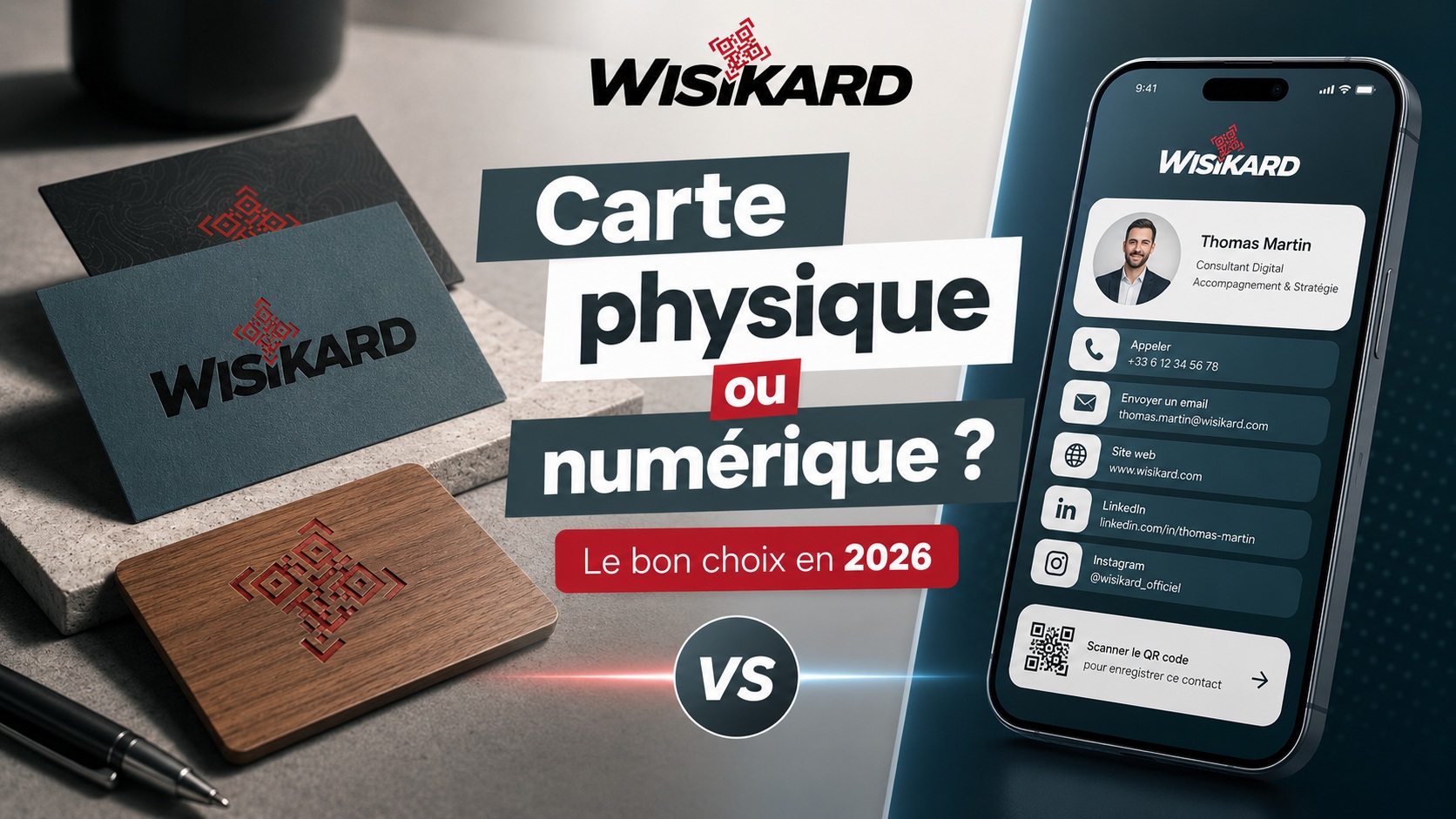
In 2026, the business card remains an essential tool for exchanging contact information and expanding your professional network.
But the format is evolving.
On the one hand, the physical business card retains the advantage of being tangible, easy to hand out, and immediately recognizable. On the other hand, the digital business card It allows you to share much more information, update your contact details at any time, and connect a prospect directly to your digital presence.
So, should you go with paper, digital, or a combination of both?
Will physical business cards still be useful in 2026?
Yes. Despite the digitization of professional interactions, a physical business card still offers several advantages.
During a meeting, a trade show, or a meeting with a prospect, handing out a business card remains a simple and natural gesture.
- quickly share your contact information;
- leaving a physical card after a meeting;
- showcase your logo and brand identity;
- enhance your professional image;
- to make it easier for people to remember the company.
A beautifully designed card made of thick paper, wood, PVC, or aluminum can also become a powerful communication tool.
The Limitations of the Traditional Business Card
Its main drawback is simple: Printed information is final.
If you’re switching:
- phone number;
- email address;
- website;
- by function;
- address;
- social media;
Your old business cards are quickly becoming obsolete.
This means you’ll need to revise the design and place a new print order.
What is a digital business card?
A digital business card, also known as a digital business card, is a page accessible from a smartphone, typically via a link, a QR code, or an NFC chip.
It includes all the information found on a traditional business card while allowing for much more content to be included.
- phone number;
- email address;
- business address;
- website;
- social media;
- hours;
- itinerary;
- photo gallery;
- videos;
- PDF documents;
- catalog;
- brochure;
- booking link;
- payment link;
- contact form;
- restaurant menu.
A digital business card thus becomes a true gateway to all your professional communications.
The Benefits of Digital Business Cards
Information that can be updated at any time
That’s probably its biggest advantage.
With a digital business card like Wisikard... information can be updated from a dashboard without changing the QR code that has already been shared.
This means you can update your phone number, schedule, links, or documents without having to replace your business cards.
Much more information than a traditional business card
A physical business card should remain legible and relatively minimalist.
Digital business cards, on the other hand, allow you to centralize a wide range of content without overloading the card you give to a prospect.
The QR code simply serves as a gateway to your contact information, website, social media profiles, services, and documents.
Saving contact information on a smartphone
A digital business card can also allow the person you’re speaking with to add your contact information directly to their phone.
No more manual copying:
- your name;
- your number;
- Your email address;
- your business.
Better integration with your digital tools
A digital business card can direct the visitor to take action immediately.
| Need | Possible action |
|---|---|
| Schedule an appointment | Calendar or booking tool |
| Discover our services | Website |
| Order | Online Store |
| Pay | Payment Page |
| Find Us | Guide |
| View the menu | Restaurant menu |
Physical or Digital Business Cards: A Comparison
| Criteria | Physical Business Card | Digital Business Card |
|---|---|---|
| Hand-Delivered | Excellent | QR Code or NFC |
| Editable information | No | Yes |
| Amount of information | Limited | Very important |
| Social Media | Address or QR Code | Direct Access |
| Documents and videos | No | Yes |
| Contact Information Storage | Manual | Available with just one click |
| Statistics | No | Yes, depending on the solution |
| Reprinting after modifications | Yes | No |
Why is the QR code changing the way we use business cards?
The QR code bridges the gap between physical and digital formats.
A business card can now be very simple:
- name;
- business;
- function;
- logo;
- QR Code.
The prospect then scans the QR code to access additional information.
The same principle can be applied to:
- a flyer;
- a brochure;
- a showcase;
- a vehicle;
- a quote;
- an invoice;
- a badge;
- a counter;
- a professional booth.
What about NFC cards?
NFC technology is another option.
Instead of scanning a QR code, the prospect simply holds their smartphone up to the card.
NFC offers a modern experience, but QR codes still have several advantages:
- It’s instantly recognizable;
- It works on virtually all smartphones;
- It requires no special explanation;
- It can be printed on almost any material.
Both technologies can also be used together.
The Best Solution in 2026: Combining Physical and Digital
Pitting physical cards against digital cards isn’t necessarily relevant after all.
The best approach is often to use a combination of both.
This way, you get to keep the physical experience of a real card while taking advantage of the possibilities of digital technology.
This is precisely the approach proposed by Wisikard.
A physical Kard to give your digital card a tangible presence
Wisikard also offers Custom Physical Kards.
Wooden Kard
For natural, warm, and original communication.
Particularly well-suited for:
- artisans;
- restaurant owners;
- businesses;
- creators;
- local businesses.
PLA Kard
3D printing makes it possible to create different formats and colors.
It’s particularly well-suited for professionals who want to tailor their business cards to their brand identity.
Aluminum Kard
A more understated and premium solution, particularly well-suited for:
- executives;
- salespeople;
- consultants;
- independent professionals.
One card for multiple uses
For a craftsman
- contact information;
- Projects;
- website;
- Opinion;
- social media;
- Request a quote.
For a sales representative
Kard makes it easy to save contact information after a meeting or a trade show.
For a restaurant
- menu;
- hours;
- reservations;
- itinerary;
- social media;
- delivery platforms.
For a business
The Kard can be placed on the counter or in the display window to centralize the business’s key information.
A business card that evolves with your business
Your business is evolving.
Your business card can now evolve along with you.
- You’re adding a new service: you integrate it;
- If your schedule changes, you can update it;
- You’re joining a new social network: just add the link;
- You’re replacing your brochure: you’re updating the document.
The QR code, however, remains the same.
Physical or digital business cards: which should you choose?
Choose a traditional physical business card if:
- You don’t hand out many business cards;
- Your contact information rarely changes;
- You only want to share a few pieces of information;
- You prefer printed materials above all else.
Choose a digital business card if:
- you want to update your information regularly;
- You have multiple social media accounts;
- You want to showcase your services or documents;
- You want to make it easier for people to get in touch with you;
- You need statistics;
- You want to centralize your communication.
Combine both if:
You want to enjoy the best of both worlds.
A Physical business card featuring a QR code that links to a digital card This approach allows you to maintain a professional image while offering a much more comprehensive experience to prospects.
Wisikard: The Business Card Designed for 2026
Wisikard allows freelancers, artisans, shop owners, restaurant owners, salespeople, and businesses to consolidate their communication through A unique QR code that’s always up to date.
From a single Kard, you can share:
- your contact information;
- your schedule;
- your social media accounts;
- your website;
- your photos and videos;
- your documents;
- your services;
- your reservation;
- your payment methods;
- Your itinerary.
You can then edit this information from your dashboard without replacing the QR code that has already been shared.
Conclusion: Should We Do Away with Paper Business Cards in 2026?
Not necessarily.
Physical business cards remain an excellent way to make a first impression and leave a tangible memento after a meeting.
On the other hand, limiting yourself to just a few printed details is becoming less and less relevant when a company’s entire business is also present online.
In 2026, the best approach is often to combine a high-quality physical card with a scalable digital business card.
Physical cards create the initial connection. Digital cards allow you to continue the relationship. And QR codes bridge the gap between the two.
Discover Wisikard and create your digital business card:
https://wisikard.fr/#offre
FAQ – Physical or Digital Business Cards
Does a digital business card replace a paper one?
A digital card can completely replace a physical one, but the two formats can also be combined. For example, a physical card with a QR code provides access to a complete digital card.
Can you edit a digital business card after it’s been created?
Yes. With a solution like Wisikard, the information can be updated without changing the associated QR code.
Does a digital business card require an app?
No. A Wisikard can be accessed directly from a smartphone’s browser after scanning the QR code.
Can you put a QR code on a traditional business card?
Yes. It’s actually an excellent way to supplement a traditional business card with additional digital information.
Which business card format should you choose in 2026?
For most professionals, the combination Physical card + QR code + digital card Today, it offers the best balance between visibility, simplicity, and the ability to update information.